
Rio de Janeiro is one of the few cities in the world where you can hike a mountain and be back at the beach by lunch. I’ve done nearly every hike in Rio de Janeiro on this list myself, only one is missing from my own boots. Here’s my honest breakdown of the best hikes in Rio, from quick city walks to a full-day climb.

Best Hikes in Rio de Janeiro: My Real Trails
This post is also available in :
Table of Contents
Morro da Urca
Rio de Janeiro

Pão de Açúcar, or Sugarloaf, is actually two peaks. A cable car runs from the base all the way to the summit, but it makes a stop at the first, smaller peak, Morro da Urca.
You can’t hike to the top of Sugarloaf itself. You can, however, hike up to Morro da Urca, and it’s a great way to skip the cable car line for at least part of the way up.
To get there, take an Uber to Praia Vermelha, then follow the coastal trail along the side. I did this one and enjoyed it, it’s not my favorite trail on this list, but it’s safe, well-traveled by locals and a genuinely pleasant walk.
Forte Duque de Caxias
Rio de Janeiro

At the far end of Copacabana, on Leme beach, sits an old military fort that’s open to visitors. The climb is short and a bit steep, about 15 to 20 minutes.
I’ve done this one too, and it’s a solid activity if you’re already walking around the Copacabana or Leme area. The fort itself is worth a look, but the real reward is the view over the whole Copacabana bay from the top.
Morro Dois Irmãos (Two Brothers)
Rio de Janeiro

This is my favorite trail in Rio de Janeiro, hands down. The morro dois irmaos hike delivers a view that covers the entire south zone, Ipanema bay, the lagoon, Christ the Redeemer and Sugarloaf, all from one spot.
The route passes through a favela before entering the forest for about 40 to 45 minutes, then opens up to that panoramic viewpoint. Some hikers go for sunrise, but I prefer late afternoon – just know the sun sets behind the mountain, so you won’t catch a sunset here. You can do it by yourself or with a guide.
Want the full breakdown? I’ve written a dedicated guide to the Dois Irmãos hike with everything you need to know.
Before you book your next tour, don’t forget to use my code HORIZONHUGO5 on Get Your Guide, it only takes a second to apply and gets you 5% off, so it’s basically free money for something you were going to book anyway.
Parque Lage to Corcovado
Rio de Janeiro

Parque Lage is known for its colonial-style building, a popular photo stop on its own. But it’s also the starting point for a forest trek leading up to Christ the Redeemer.
The climb is steep and sweaty, but manageable. I did it without any issues, though I’d read reports of theft on this trail beforehand and went in a bit nervous. My hike was about a year ago, so I can’t confirm current conditions, to stay safe, leave valuables behind. Arriving at Christ the Redeemer on foot instead of by train or car gives a real sense of achievement that’s hard to match.
Pedra Bonita
Rio de Janeiro

This is the launch point for Rio’s paragliders and hang gliders. Take an Uber to the site, walk 5 to 10 minutes to the launch area, then hike another 20 to 25 minutes to the viewpoint atop the rock formation.
The trail is easy, not very steep, and popular with visitors. I haven’t personally done this one, I chose other hikes instead, but it’s an iconic spot worth knowing about.
Pedra da Gavea
Rio de Janeiro

If you want the toughest and most rewarding climb in Rio’s south zone, this is it. The pedra da gavea hike takes 4 to 5 hours and includes a genuine climbing section, about 50 meters of bare rock with no walking path.
I did this one myself, and it’s easily one of the most memorable experiences I’ve had in Rio. I even flew my drone from the summit, and the footage was stunning. You get a 360-degree view, and it’s impressive!
If you’re not comfortable scaling rock by hand, local companies offer assistance for around 50 reais for that stretch. I watched Brazilian locals climb it barefoot, moving with total ease, it’s clearly not too dangerous if you know what you’re doing, but it’s not a hike to take lightly either. Bring snacks for the descent, since this one takes a lot out of you.
Pedra do Telegrafo
Rio de Janeiro
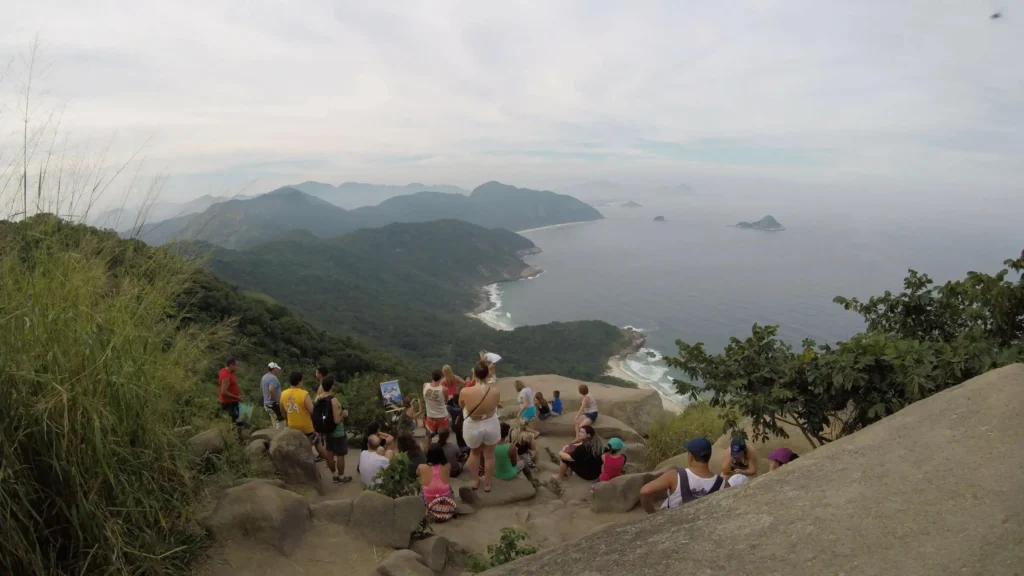
This hike sits farther from central Rio, so plan on an Uber and maybe splitting the cost with others. It’s famous for one very specific photo spot, a rock ledge that creates the illusion you’re hanging in midair.
I did this trail, and while I skipped the photo op because of the line on a sunny day, the hike itself was enjoyable. There are beaches and a small town nearby for food afterward, and the views along the way are genuinely pretty.
Tijuca Forest Treks
Rio de Janeiro

Beyond the city hikes, Tijuca Forest has several trails worth exploring, all centered around waterfalls, dense jungle and more wildlife than you’ll find on the coastal trails. It’s a good option if you want a deeper nature experience without leaving the city limits.
Bom Retiro is one of the most famous trail in Tijuca forest. I haven’t done this one myself, but I’ve heard many great things about it.
A Few Things to Know Before You Go
A handful of small details can make a big difference on these trails.
- Summer brings more crowds on every trail on this list, so expect company, especially on weekends
- Bring plenty of water, vendors aren’t always around, and you’ll sweat more than you expect
- Pack snacks, especially for longer hikes like Pedra da Gaveia
- Bring a banana or two if you want a chance encounter with the small monkeys that live in Rio’s forests – they’re common and generally friendly.
Planning the Rest of Your Rio Trip
These hikes cover what’s realistically doable for a visitor spending about a week in Rio. If you’re craving something more remote and mountainous, towns like Teresópolis and Petrópolis sit in Rio’s wider highland region and offer their own set of hikes – just outside the scope of this guide.
Still building out your Rio itinerary? Check out my guide about all the things to do in Rio de Janeiro for more ideas, where to go out in Rio, and my full Brazil itinerary guide if you’re planning the whole trip.
This post is also available in :


I'm Hugo, a traveler driven by curiosity and a passion for discovering the world's hidden corners. After exploring over 30 countries across Latin America and Southeast Asia, I've learned that every adventure shapes who we become. I'm here to share those lessons and inspire your next great journey.
Subscribe to the Newsletter
Join our community and receive exclusive travel stories, guides, and special offers!

🗺️ Planning a Trip?
Skip the research rabbit hole.
I’ll build you a personalised day-by-day itinerary — or answer all your questions on a quick 60-min call.
Affiliate Disclosure
Some of my posts include affiliate links. If you choose to make a purchase through them, I may earn a small commission—at absolutely no extra cost to you.
Using these links is the best way to support my work and say thank you, and I appreciate it so much! Of course, everything I share reflects my honest opinions and experiences.
📸 Work With Me
Brand, tourism board or hotel?
Let’s create something together — content, reviews and campaigns that reach real travellers who are ready to book.

Latest Posts

I crossed four South American borders and struggled...

This three-day route from Ho Chi Minh City covers the...

This Ho Chi Minh City travel guide covers District...

Discover what to expect at the Cu Chi Tunnels, how...

Discover the key differences between Lan Ha Bay and...
Get My Personal Map of 500 Must-See Places - FREE
I’ve compiled 500 of the best places across my travels into one free Google Map.
The kind of spots you won’t find in a guidebook.

Table of Contents
Got Questions?
Still figuring things out for your trip, or just want to double check something before you book? Send me a message and I’ll get back to you as soon as I can.
Or hit me up on Instagram, I’m there anyway and always happy to chat about the trip.
You might also like to read these articles
17 October 2026
WanderWallet Review: Pay Like a Local Across South America
I crossed four South American borders and struggled with a different payment system at each one, until...
15 October 2026
Ho Chi Minh to Phnom Penh by Boat: 3 Days on the Mekong
This three-day route from Ho Chi Minh City covers the Mekong Delta, lychee farms, flooded forest, and...
12 October 2026
Ho Chi Minh City Travel Guide: What to See, Do, and Know Before You Go
This Ho Chi Minh City travel guide covers District 1 landmarks, the War Remnants Museum, Cu Chi Tunnels,...
09 October 2026
Cu Chi Tunnels: Complete Tour Guide from Ho Chi Minh
Discover what to expect at the Cu Chi Tunnels, how to get there from Ho Chi Minh City, and whether this...
04 October 2026
The Best Cruise for Adventure: 5 Expedition Voyages for Active Travelers
A cruise trip doesn't have to mean sea days and buffets. These five expedition voyages mix cruising with...
01 October 2026
Ha Long Bay vs Lan Ha Bay: Which Vietnamese Bay Should You Visit?
Discover the key differences between Lan Ha Bay and Ha Long Bay. Both UNESCO sites offer stunning limestone...
27 September 2026
Cat Ba Island: Your Complete Travel Guide
Discover Cat Ba Island, Vietnam's quieter alternative to Ha Long Bay, offering limestone karst scenery,...
24 September 2026
How to Travel to Hanoi: Complete City Guide
Discover how to travel to Hanoi with this comprehensive guide covering neighborhoods, transportation,...
22 September 2026
Sapa Trekking: Why the Hmong Valley Trek Is Worth It
I trekked Sapa's rice terraces on foot to see what the Hmong valley is really like beyond the brochure....
17 September 2026
Hanging Bridge Costa Rica: A First-Timer's Guide
From the Mistico Arenal Hanging Bridges Park in La Fortuna to the Monteverde Cloud Forest Reserve, here's...